

33. Seduction and the Self
Like thorns on roses, seduction has mean teeth. It can (and will) bite.


“April is the cruellest month, breeding / Lilacs out of the dead land, mixing / Memory and desire, stirring / Dull roots with spring rain”
by T.S. Eliot, from “the Waste Land” (1922)
Good news! The White Lily Society Archive has been officially resurrected from the dead, thanks to the lovely and beyond patient Sarah (@ slitchell on Instagram) and her tiresome work. The archive is the Society’s very own curated collection of academic reading and resources, organised by topic. You can browse all the previous archive sources there, as well as many more yet unmentioned. Happy reading, my dear ˚₊‧꒰ა ☆ ໒꒱ ‧₊˚

01/04/2026, London, UK
My dear,
It’s been ages since my last letter! Too busy and too practical of a life makes for boring letters, a chronic lack of dramatics. January, February, even March, I spent settling into a new skin, a new home; I’ve written about the adjustment extensively. To say wholeheartedly that my world has returned to spinning would be a lie. Rather, I am still in that odd limbo, I still walk into phantom furniture or boxes half unpacked. Forgive me, I would sew my life back together, had I not misplaced my needles in a haystack of stress. And God only knows when the thread will see it fit to reappear from its seamstress sabbatical.
Well, writers are fickle creatures, it takes only the smallest gust of wind to make them fear the worst. The ink drying up inside of their porcelain heads— I am no exception! And disaster, unlike lightning, did strike twice! Yours truly found full-time (for now) empl0yment at a hotel… consequently my dreams are filled with room numbers, fairytales of many keys, the crowding algebra of the people-pleaser. Amenities (complimentary or not), bed sizes, infinite requests. At night, my afflicted self imagines check-ins and check-outs, on endless revolving loop. I dream of allocating guests to the storage room, where they are forced to sleep on stacks of mattresses, sans pea. And I do not blink when, within those same dreams, my name on the rota morphs into [the] “Bride of Frankenstein”. I have always felt married to monstrosity in one way or another. A natural result of the company I keep, I would imagine.
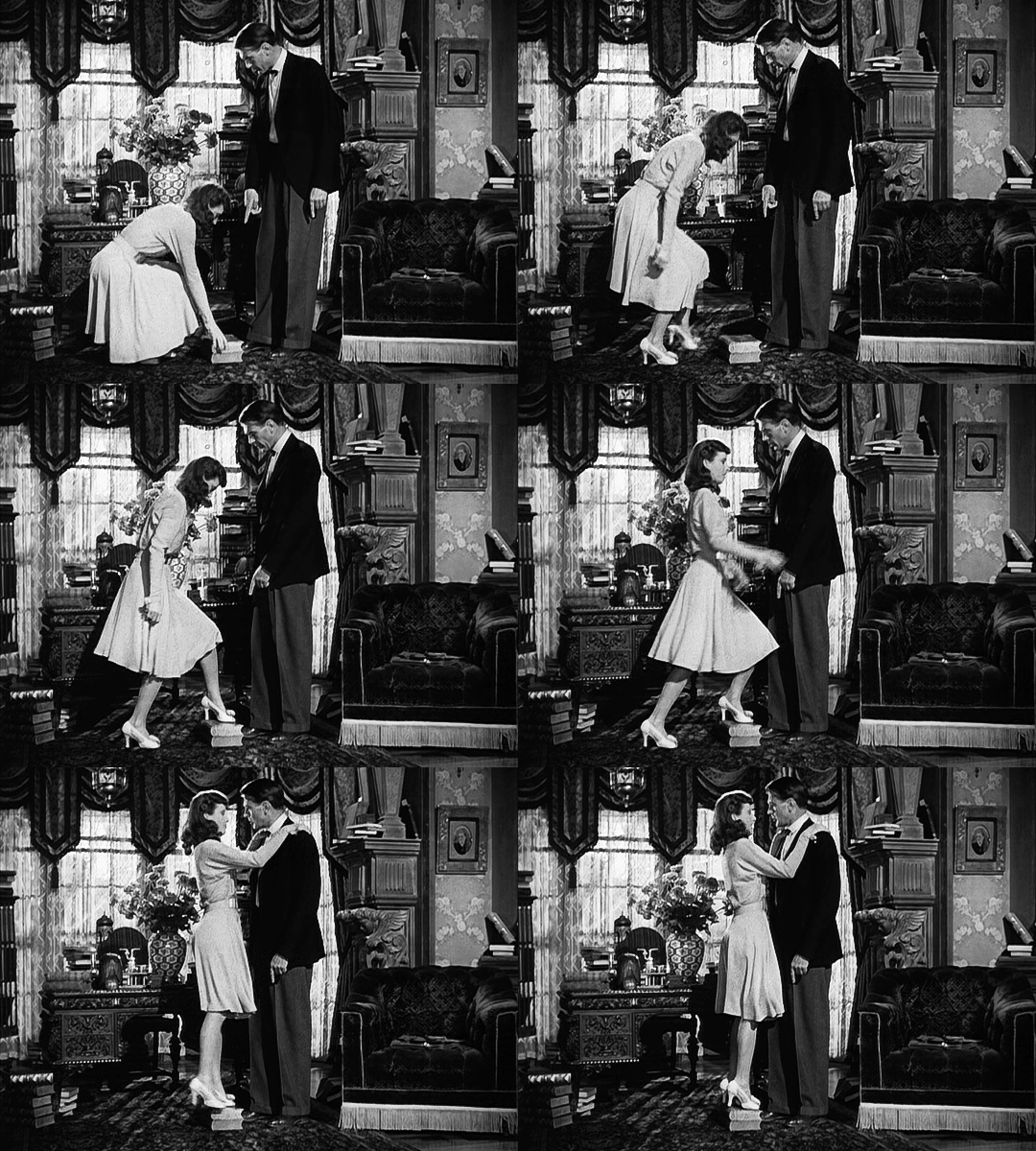
Yes, I am always reporting back on my dreams in one way or another, for they are so enmeshed with me. This society- and by extension, you- are like a sixth finger to me, or a third eye, and so I must pass you my dreams in “little” crumpled notes every months, thousands of words long. Especially when they come true, my dear. But my absence has been coloured with seduction; I met my personal idol Dita Von Teese, attended revels, and wore stilettos to the point of permanently damaging my left foot (true story). The left side of the body is the side of emotional, intuitive side, but I digress. Now, with my personal copy of “the Art of Seduction” (2001, front lettering worn off over the ages) signed by the queen of burlesque herself, I feel properly empowered to bestow my erratic musings on you and unspool a letter woven over the course of years. Not months, not days. Together with a kiss, a peek of a silk stocking (cuban heeled, seamed with keyhole welt, of course), and a few champagne truffles, my dear.
Now, give me a kiss! It’s been far too long for a girl locked in her tower…
‧₊˚🖇️ ✮⋆˙ ₊˚💌⊹⋆。𖦹 ° This newsletter contains the following sections:
I. Archive Sources (MIA) // II. Notes on Seduction: a Personal Philosophy // III. On Idols and Hypnotism (TBA) // Outro
I. Archive Sources
[Aw shucks! I could have sworn I placed the archive sources for this month in one of these moving boxes I’ve yet to unpack… Let’s mark this one as “in transit” for now… No doubt it will show up when I finally find the time open these treasures of mine…]
II. Notes on Seduction
“Once you enter these pages […] let yourself be lured by the stories and ideas, your mind open and your thoughts fluid. Slowly you will find yourself absorbing the poison through the skin and you will begin to see everything as a seduction, including the way you think and how you look at the world.”
by Robert Greene, from “the Art of Seduction” (2001), p.xxv
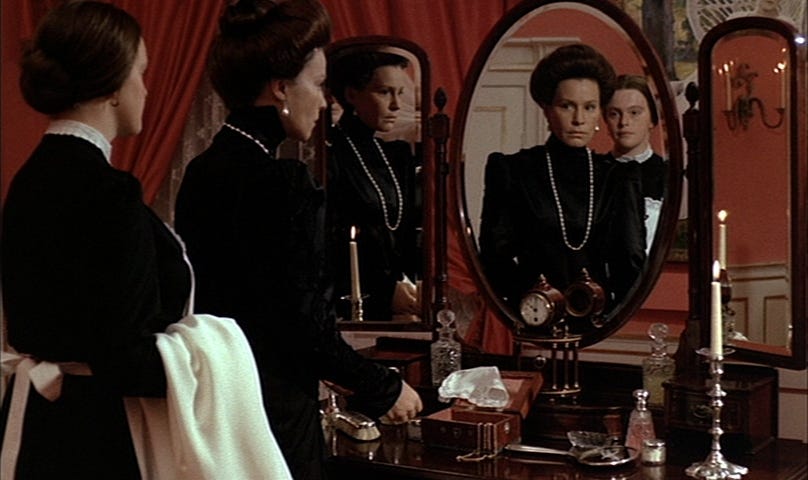
Seduction has been a topic long-coming, my dear. It has been an inevitable force, inbound for the immovable object that is the Society. Rather, in many ways, the White Lily Society is a product of it, a seductive force in its own right. A home away from home, a realm of pure fantasy, and a daydream potent with hope. In this light, fantasy is always speculative to me. Aspirational. Often, we set courses for ourselves without knowing it, and we end up walking the path we both needed and wanted. This is what it means to be seduced; that fickle, strange influence of something existing both congruous with- and outside of ourselves. Forgive me for dropping you into its maws without warning, let me retread some of my footsteps.
I am thinking about seduction because (1) it is an inevitable force in life, and (2) because it has been a topic of ardent relevance to me in the past few months. I suppose it is also a slight personal obsession of mine; I am always hungry for tales of those led astray. Though truthfully, when thinking of seduction, I am always much more uninvolved with the iconography than its philosophy; us mortals are visual creatures, my dear. Take it from somebody who quite literally has a masters degree in aesthetics1… Though I don’t mean to dominate. Fantasy is like catnip or absinthe or glass filled with smoke. Intoxicating, perplexing, hard to grasp. The symbols of it are much more easily laid out than its philosophies. But I will still bravely attempt a dissection today.


II.I Coquettes and Charismatics
“The siren call of seduction is irresistible because power is irresistible, and nothing will bring you more power in the modern world than the ability to seduce. Repressing the desire to seduce is a kind of hysterical reaction, revealing your deep-down fascination with the process; you are only making your desires stronger. Some day they will come to the surface.”
by Robert Greene, from “the Art of Seduction” (2001), p.xxi-xxii
If one asks me what I mean with the term “seduction”, a sum of branching synonyms come to mind, like flowers blooming simultaneously. Variety is what makes the bouquet interesting. Seduction is fantasy, imagination, hope, allure, desire, intent. It is an odd blend of conscious and subconscious; the shadow self. It is glamour and sensuality. It is a lifestyle, a transformative practice. But it does not have to be so in a romantic context per se. Self-seduction has never been divorced from “regular” seduction in my mind— this is important to note for what’s to come.
Historically, the art of seduction is fraught with duality, as will be a common theme throughout this letter’s many musings. Eroticism is contradictory, after all. There are great differences, both in symbols and in attitude, between the male seducers à la Don Juan, and the femme fatale like the great courtesans of yore. Read any history of seduction, and you’ll notice quite quickly that there is a distinct personality split in its still-ongoing narrative. When it comes to the visuals, the lures and temptations, the semiotics of seduction, the language is distinctly feminine. However, when it comes to the more unsavoury parts, the misdirections and quick-changes, the magician’s sleight of hand, [romantic] seduction falls distinctly under the custody of men— when seduction laws still existed in the US, for example, they were largely in place to protect women, and did not seem to exist at all for inverted scenarios (see “Strange Antics: a History of Seduction” by Clement Knox, 2020). I should not need to point out the patriarchal ideas latent in this divorce; when feminine “virtue” is a resource to be hoarded and conquered, the onus is on women to be the jailers of their own desire, and on men to pick the locks in whichever way they can.
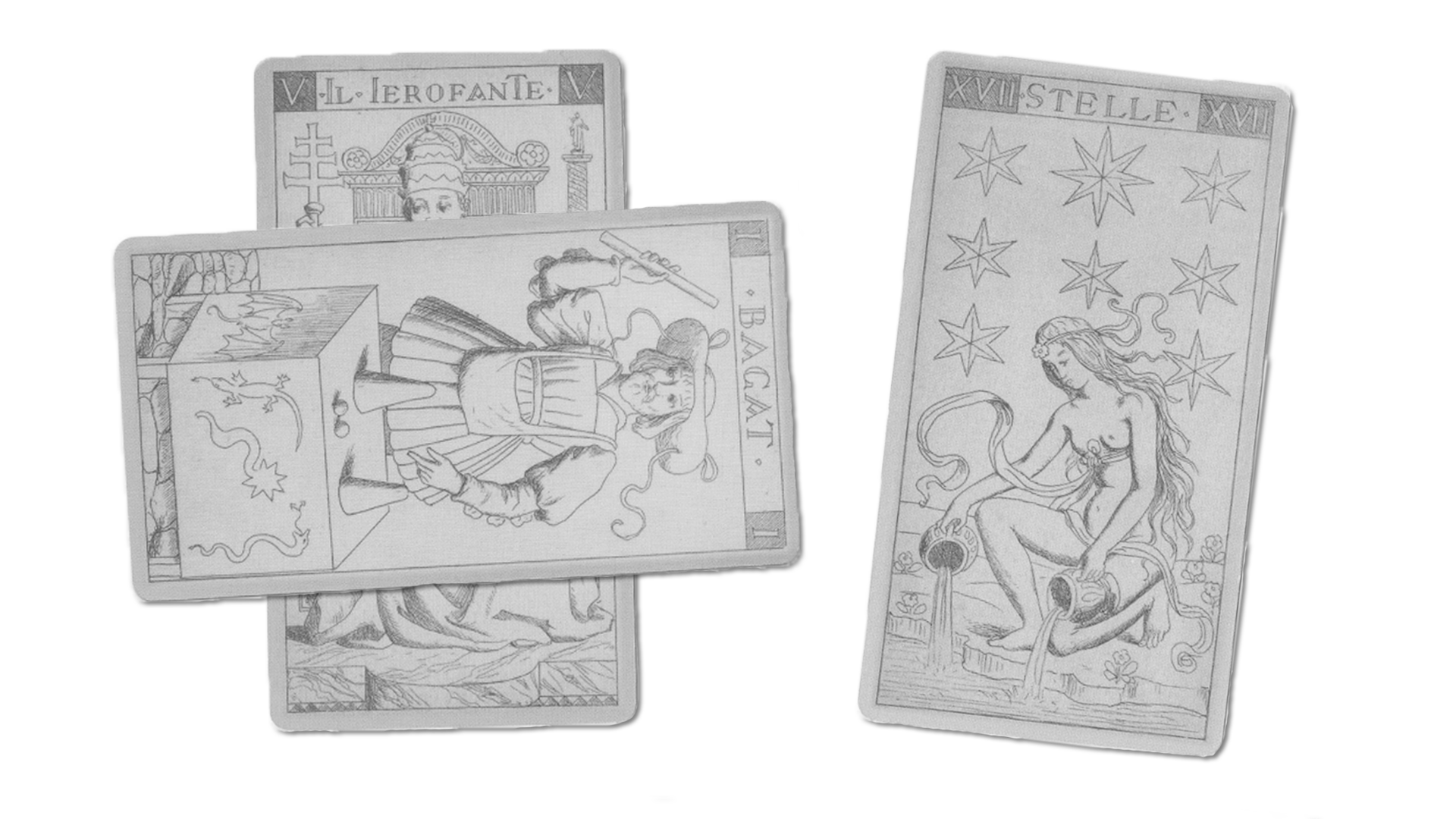
This is not a defense nor a critique of either side, my dear. What interests me more than the blame-game is the associations of seduction. The layers of its temptations. Arguably, the allure of seduction is two-fold; the fear of the attacker and the fear of the victim share a subtext. Those who can’t be seduced, seduce. After all, everyone already has the language and the tools equipped within them, but coded in reverse. A simple enough premise, and yet there is something of the divine in the seducer, something of the magician-priest in their incense smoke-screen of words. Some innate sense that enables their perfect performance, that blurs the lines between instinct and learned behaviour. The hierophant upright, crossed with the magician. The star on the side, eager with anticipation. Draw a final card to see whether you’ll succumb.
II.II Soul-Sworn Serpents of Seduction
“Eroticism is, first of all, the most moving of realities; but it is nonetheless, at the same time, the most ignoble. Even after psychoanalysis, the contradictory aspects of eroticism appear in some way innumerable; their profundity is religious—it is horrible, it is tragic, it is still inadmissible. Probably all the more so since it is divine.”
by Georges Bataille, from “Eroticism” (1957)
But Greene writes that seduction is not a performance, in the sense that the seducer is never off-stage. Any and all interaction could be a seduction, and the seducer crafts a life, a persona, and a history for this very purpose. They take absolute pleasure in this playful fluidity. Seduction, then, is the art form of both the body and of the soul. Contradictory desires, like I said, my dear. Sensuality, while latent with expectations of physical sensation, is really about philosophy. The philosophy of touch, of what is inside of you, versus what is outside of you, and which individual facets we’d like to switch places in that dichotomy. If seduction is innate, both in terms of what seduces us and what is seductive about us, then any good scholar of it would be remiss in neglecting to mention the soul. That elusive light, the epitome of belief and hope and imagination. A religious concept, yes, but seduction is like religion in that it is a spiritual game of the senses. Therefore it is only natural to branch into it a bit, to let lines blur as they wish to.
In the Western world’s dominant theology, that of Christianity, the soul and the body are largely believed to be unified to an extreme extent: “The unity of soul and body is so profound that one has to consider the soul to be the “form” of the body: i.e., it is because of its spiritual soul that the body made of matter becomes a living, human body; spirit and matter, in man, are not two natures united, but rather their union forms a single nature.”2 Seduction is the defense of (and the attack on) the body and soul, which are one, fused together, enmeshed to such an extent that we cannot begin to understand where, spiritually, one starts and the other ends. Naturally, what threatens one, threatens the other. Seduction is a siege of totality.


The three enemies to the soul (according to Christian theology) are (1) the world, (2) the flesh, and (3) the devil. Seduction has a taste of all of these; it is often a force associated with the lure of adventure, the fantasy of a life outside oneself. It is associated with the flesh and its myriad of temptations. Touch and taste. Skin on skin. Flesh, to be exposed and covered up; the seductive performance of adding and taking away. And the seducer itself has something of the devil in them, that charming figure with hand outstretched. At least the hell he leads you to is fresh and new, my dear. Its horrors are not so mundane as the ones we already know.
But if we place these ideas- seduction and its dependents: fantasy, imagination, temptation, hope, desire- as enemies to the soul, does that mean one is naturally devoid of them? What purpose does seduction hold as invasive force? Is the soul just the seat of the mundane? To say so would be to over-simplify; the devil in abstract is understood not to be a man with horns, but an impulse inside of us. The beginnings of temptation are always latent within soul / spirit / self. Seduction, I would argue, is then a completion of sorts. It is the very peak of Maslow’s hierarchy of needs; self-actualisation is seduction. The grasping of fantasy, no matter how slight. Unification with something we have always perceived to be just out of reach. Fingertips touching, tasting, that which we have only tasted in dreams. This is what it truly means to be seduced.
II.III Change (in the House of Flies)
“Desire, the erotic imagination, the erotic life, all cross through bodies and make them transparent. Or they destroy them. Beyond you, beyond me, through the body, in the body, beyond the body, we want to see something. That something is erotic fascination, that which takes me from myself and brings me to you: that which makes me go beyond you. We do not know precisely what it is, except that it is something more. More than history, more than sex, more than life, more than death.”
by Octavio Paz
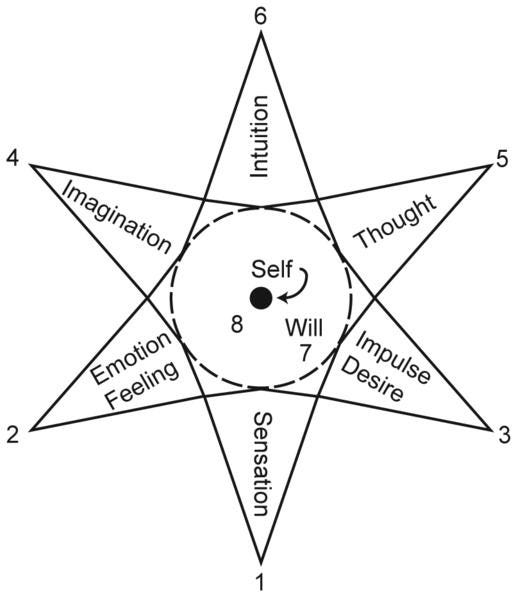
This is where my thesis starts to unfold, like a [white] lily in bloom. Arguably, desire is the breath of life. Angela Carter, in her 1972 novel “the Infernal Desire Machines of Doctor Hoffman”, rewrites Descartes’ famous motto as: “I desire, therefore I exist”. Truly, to live as a conscious being is to desire. Imagination is a human right of its own, a self-perpetuating force. The soul and seduction are chasing each other like a pair of hounds, fervent and foaming in their pursuit. And though seduction has largely been portrayed as the anti-productive pursuit, the hedonistic destruction of the self-obsessed, my argument poses that all the aforementioned dependents of it (and thus seduction itself) are, in fact, driving factors in the renewal of the self. Teethmarks on skin from where the beasts have finally held their gruesome meeting;
“you dangle on the leash / of your own longing; / your need grows teeth.”
by Margaret Atwood, from “Speeches for Doctor Frankenstein” (1966)


Now we have reached the core, the pit of seduction’s fruit-flesh: seduction as a regenerative force. A balm for the soul, rather than a strategy of war. An arrow of prayer sent out into a cruel world, intention in the softer sense of the word. Simone Weil writes that “Absolutely unmixed attention is a prayer” (from “Gravity and Grace”, 1947), and Florence Welch sings “And prayer is a spell” (from her song “Perfume and Milk”, 2025). At least this spellbinding aspect is a constant force in seduction; the looking at something we cannot avert our gaze from. Hypnotism, intention. A gilded pocket watch dangling mere inches from our many faces.
Taking from Bataille’s view of eroticism and desire as being irreconcilably intertwined with pain, the constant and simultaneous fleeing from and running towards seduction is what prompts us to look outside of ourselves. Bataille argues that eroticism is found in the dissolving of the self, the moment in which we, as discontinuous, fragmented beings, enter a space of continuous wholeness. To be unified with the pantheon of seductive forces, as an erotic process, is the transformative truth of self-possession. The antidote to routine and the mandatory is to absorb more of its opposites. The self grows and the world grows less oppressive with it.
That stagnation is bad for the soul is far from a new notion; still rivers grow rot. So too is stagnation what grows rot in our lives. It is the killer of [life’s] enjoyment. This is true for a lack of transformation, as well. While there is certainly value to be found in stillness at times, it is uniquely satisfying to develop. To see progress being made. Preferably for the better, of course, but all exploration has some merit of its own. Even rock bottom had to be mapped out, and we do so by running our fingertips over the coarse granite. Pressing a kiss to the cold stone surface of it.
But the seducer is never far from the trail, my dear, if my beloved fairytales have taught me well. Sometimes they just need to course-correct: reach for the compass, redraw the maps, rediscover their true north.
One tool in the seducer’s arsenal of mock-cartography is glamour; that distinctly human brand of artifice. The pilgrimage of seduction. Self-appointed glamour evangelist Dita Von Teese has spoken at length about her love for made icons. A fascinating blend of what is innate, and what is not. The duality of inside/outside. In a 2014 interview with Glamour magazine, Von Teese said; “I like painted ladies, you know? That’s one of the reasons I like the ‘30s and ‘40s. Glamour was not about natural beauty; it was about creating drama. So like Marlene Dietrich, Rita Hayworth, Marilyn Monroe, and Betty Grable. When you look at the before pictures and the after pictures of all of those women that I mentioned, you see that how they became really exciting is with all of these tools of glamour. It didn’t happen naturally. I love this whole concept of the old-Hollywood makeover, and I was obsessed with that. I mean, I did it for myself: I’m a natural blonde from a farming town in Michigan; I’m not like this at all. I created it, and anyone can do it for themselves.”


When I speak of seduction, this is what I fixate on most of all: seduction is about finding a mode of expression that fits you— and in this purpose I see no point in distinguishing between the seducing of others and the seducing of the self. After all, the Eastern philosophy of tantra states firmly that what is outside of us is also within us (see also; “Tantra” by André Van Lysebeth, 1992). Christian theology, as we have seen, posits the body and soul as one. Seduction aims to expand this spiritual body of ours into something aspirational, fulfilling. Resonating. Artificial to some extent, but not wholly so. Life is best lived as a character, after all. How far to reach for this alter ego is completely up to you, my dear. Franz Kafka wrote; “I was ashamed of myself when I realized life was a costume party; and I attended with my real face.” Perhaps we have too long erred in calling the intentional artificial; really, all artifice is a craft or a tool.
There is no shame in active participation in the self, rather, you’re much more likely to find absolute power in it. Packing emulation and inspiration, and setting out for the grand adventure of fantasy, imagination, hope. Seduction, to me, has always been a firm grasping of this power. Learning how to handle it, treat it the way it wants to be handled. Alternating rough and tender touch. Seduction slips through the fingers like silk or stream; it curls like little tendrils of fog— literally wraps around one’s finger (take note of the romantic expression of the same verbiage). Seduction is a songbird, and the boundaries of our imagination, our daring, form the cage.


Then, seduction is a human need, precisely because it is a connection to ourselves, a tether of sorts. So much of the strategy of sensuality is intentional, requiring thought. And the end result, the fantasy embodied, even if only partly, serves the first and foremost purpose of strengthening that connection. Reinforcing selfhood and our place within it. Seduction is a positive feedback loop, it is neural pathways in the brain, it is a fountain of youth. In the age of despair, it offers something distantly unreasonable, but all the more potent; the channeling of escapism, injecting it straight into your life.
Though it begs the question; Is it still artifice if you are actively living it? How much of the dream can we inhabit before it became wakefulness? Is there not a substantial amount of power in being one’s own seducer?
If you play your part just right, you’ll find a seductive persona that complements you, that challenges you, that inspires you. This is a turning point in our narrative; while, aesthetically, you can change virtually everything about yourself, the fine-tuning of fantasy does require congruence with your character to some extent. All the best aesthetics are the ones that speak to us, call to us. Some we are predisposed to from a young age, and some we grow into. Briars form barriers, composed of shame, or shyness, or social conditioning, holding us back. Seduction is in the business of returning to the lost self, both past and future— breaking through the walls we have subconsciously put up, for which we have undoubtedly put the blame onto others. Like thorns on roses, seduction has mean teeth. It can (and will) bite.
II.IV Into the Rose Garden
“If you want the moon, do not hide from the night. If you want a rose, do not run from the thorns. If you want love, do not hide from yourself.”
by Rumi
Julia Cameron’s extremely successful creativity course “the Artist’s Way” (1992) talks about inspiration as a well of images, that has to be refreshed just as much as it can be drained, if not more. Yes, creativity is a trick of the senses, and so is seduction. My favourite chapter in “the Art of Seduction” (2001), is the one on “poeticising” one’s presence. It is no wonder, then, that sensuality often takes centre-stage in seduction. The headliner is the very act of returning to our senses, our symbols. A language seduction is beyond fluent in. All hope starts with a pertinent image which we let crystallise. For me, as your gracious host, full-time courtesan, sleepwalking-beauty, vampire bait, and afflicted melancholic, this fantasy involves a diet of fruit, chocolate covered cherries, and champagne. Fabulous nights of hosted debauchery. Silk stockings and stilettos. Flowers from admirers. Languid mornings with a salacious book and heavy lace robes. The symbols we choose for ourselves hold a deep fascination in the seductive (and sensual) process.
Seduction is the subject of song, of tales far outliving their initial inspirations. The lingerie might come off but it serves its purpose much longer than that; the latent image festers. Once the fire of myth takes hold, it tends to burn the house down. Take the rhymes invented for the scandalous society writer Elinor Glynn (“Who would like to sin with Elinor Glynn / on a tiger skin? / Or would you like to err with her / on some other fur?”) and London highway man Claude du Vall (“Here lies DuVall: Reader, if male thou art, / Look to thy purse; if female, to thy heart. / Much havoc has he made of both; for all / Men he made to stand, and women he made to fall”). Our sinking into the seductive gives great importance to symbols, because myth gives great importance to symbols. All the age old fairytales are known for objects rather than events; the glass slipper, the poison apple, the lonely tower. Semiotics is the native tongue of the seducer.


Historically, the feminine side of seduction is much more symbol-heavy than the masculine side: “Although outwardly dispossessed of her rights in culture, the seductress, Baudrillard believes, creates mystery and elusiveness through the use of symbols and appearances, tricks and artifice, and, in particular, her erotic presence.” (from “Seduction: a Celebration of Sensual Style” by Caroline Cox, 2006). It seems that women are more often concerned with the making of the seductive myth, involving each and every sense. “Pleasure seduction”, you might call it. The painted ladies of Dita Von Teese’s cinematic background, the immortal image we can conjure up at the slightest of our whims. The “Other” Woman, who “enchants her clothes with French perfume / […] keeps fresh-cut flowers in each room.” (from a song by Lana del Rey, 2014).
But She is “Other” only in the sense that is she not an integrated part of the whole. You see, my dear, within each of us there is a shadow self, not just in the psycho-analysis sense of the term, but in the seductive sense. Next to ego, superego, and id, there is the fourth shade, the fantasy self. Unbridled, pure potential. So, contrary to popular belief, seduction is more about a persona that completes us, rather than a person. In traditional seduction narratives like the tales of Don Juan, these are one and the same, they share the same amount of dimension. The temptation is an Other we wish to absorb. Blurring the boundary between inside/outside. The persona exists outside of us and partially within us in the form of potential; spiritual demi-monde. I am reminded of T.S. Eliot’s poem “Burnt Norton”3, which starts:
“Time present and time past
Are both perhaps present in time future,
And time future contained in time past.[…] What might have been is an abstraction
Remaining a perpetual possibility
Only in a world of speculation.
What might have been and what has been
Point to one end, which is always present.
Footfalls echo in the memory
Down the passage which we did not take
Towards the door we never opened
into the rose-garden.”
by T.S. Eliot, from “Burnt Norton” (1936)
I’d like to think of the end purpose of seduction as the rose garden. To be fully within it, and conscious of it. The antithesis of Plato’s cave. Each step closer to our ideal persona gets us a step closer to the garden. Undoubtedly, this is a form of simulacra, as Baudrillard theorised— the persona has very little to do with reality, rather it is a tool to enhance one’s own. Hyper-reality, the copy of a negative long destroyed. “Ideal”, then, is a tricky word to choose in relation to it; our idealised persona should be rooted in a melange of our natural attitudes, our desires, our predilections. Seduction is a strategy of absorption: its layers are symbolic, spiritual, transformative. The rose garden has thorns, naturally. But so does everything else. The time will pass regardless; there is none of it to lose in dreaming it away. The thorns and the suffering, like in Bataille’s eroticism, are all part of the process. Like the old adage that “beauty is pain”, moulding ourselves will always require at least a bit of delicious pressure.
“[…] there’s a long history of this in Catholicism. The monks used to wear thorns on their temples. And the nuns, they wore them sewn inside their clothing. [You] are part of a great tradition.”
from the film “Secretary” (2002)


II.V Final Words
“If we ever stopped to look at the present and future in a completely objective way, we would despair. Fortunately we develop the habit of dreaming early on.”
by Robert Greene, from “the Art of Seduction” (2001), p303
Supposedly there should be a point to all of this weaving, this tying of one ribbon to another, silk on silk. Not to leave you pouting my dear, but the end is always moving further away from us. No thought is ever completed, it is only finished when its creator is. The whole reason it took me so long to put (metaphorical) pen to paper on seduction is only because my thoughts on it are ever unwinding. I’ve referred to seduction as smoke, as spell-craft, as contradiction, precisely because it is such an ephemeral concept. But the touch lingers where the word doesn’t.
Perfection is both the enemy and the lure of seduction. Johannes, the protagonist of Kierkegaard’s “the Seducer’s Diary” (1843), is marked by that chase. Once the victim submits, there is no fun in the game anymore for him. In line with this philosophy, the novel ends right after the climax of his battle of wills with the object of his desire, a girl named Cordelia. We are blindfolded for the final moments and then the story ends. Anticipation and the experience of anticipation is the entire point4; “[I] work at developing the contrast, I tense the bow of love to wound the deeper” (p54) / “One likes to struggle to gain possession of what one loves.” (p63). And there he is again, my beloved Bataille. It seems he is never far away; “The likelihood of suffering is all the greater since suffering alone reveals the total significance of the beloved object” (from “Eroticism”, 1952).
But in living the seductive, the sensual, the erotic, there is a continual living in the “afterglow”. What does one do, seeing the path traversed, now behind them? That is simple enough; they stray, they lay out maps for some new conqueror’s game. Whether conscious or unconscious, the battle is never done, because the soul is never forming solid walls. It is gaseous, amorphous. The lines between soul and body and persona and the world and everything else are blurring and irregular. The seducer is continually dreaming their life. Completion is impossible, and obsolete. Therefore it is undesirable. That is what I will tell myself, sending you this letter, my dear, only to inevitably wake in a fortnight, knowing just the perfect sentence to have inserted in my tirade. A little something to savour, for next time.
III. On Icons and Hypnotism
[This section about my experience meeting Dita Von Teese at her “Nocturnelle” tour is still under construction, to appear here at a later date. Keep your eyes peeled for that. Complaints can be sent to my empl0yer. I’m sure they will appreciate your thoughts as much as I do <3]

“[You] are the dream, the nightmare, and the dream within the nightmare that becomes a dream”
from my Co-Star horoscope for March 12th, 2026
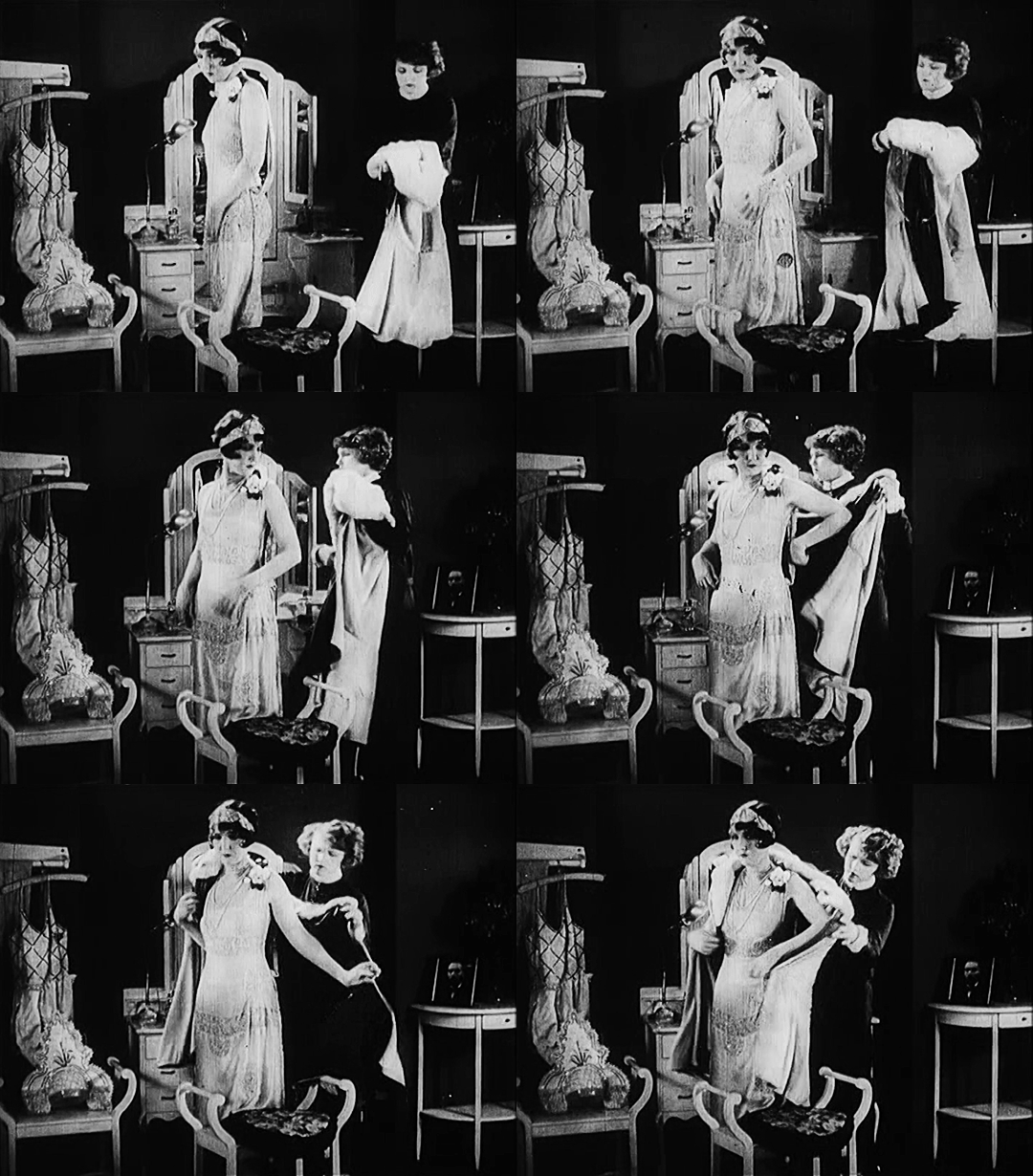
Forgive me, my dear, I have tired myself out in writing to you this month. I imagine my letter might never reach you unless I put my stamp on it, fold it away, and seal the envelope right now. Within the liminal space of my newfound routine the hours vanish, they pull away from my touch. I am overwhelmed with attention, only to have so little of it to return to others. Boxes yet unpacked, friends not yet written to, books gathering dust. Make no mistake, the thing that gets you is the dust, when you have no time to eradicate it once and for all. Eight and a half hours of the day it has free rein to host its ominous gatherings, to point out exactly what has and hasn’t moved in my absence. Stillness is frightening when it is not experienced!
Early morning, I will think of it, this dwelling place of mine. Sunrise after sunrise, exhibiting signs of madness. Under the cover of darkness, I will kiss and caress the walls of this well I call a home. Banister to banister, our embrace will be structural. Sub-flooring and all. Then on my long walks I will wonder about what it means to live a life with so little time to sing. At least I get my melodies out on paper, where they taste more like freedom than like confinement, and seduction still lives at the top of the stairwell, it cowers in corner cabinets, it beckons like an instrument of sorts. A piano or a harp, gathering dust but still shining dimly. Unfortunately the orchestra halts to a stop eventually and the sound of it dies out slowly, achingly. The music never really lives outside of us as much as it does inside of us.
Until my next letter full of odes from your favourite songbird,
With love (and violence),
x Sabrina Angelina, the White Lily Society 𐔌՞. .՞𐦯
Currently reading: “Glamour” by Carol Dyhouse // Most recent read: “the Seducer’s Diary” by Søren Kierkegaard
White Lily Society links // Sabrina Angelina links
The White Lily Society wants to be loved by you, just you, and nobody else but you! So, become a martyr of deliciousness today, and subscribe. The Intersection of Love and Violence is a girl’s best friend!
📼 Song of the (past) month: Dearly Missed - Searows
I did my masters thesis on the powers of visual advertising aesthetics on influencing young consumers’ ideas of luxury *:・゚✧*:・゚
From the catechism of the Catholic Church, section 365.
Famously spoken by Lana Del Rey on her 2015 track of the same name.
Thus, seduction is the Intersection of Love and Violence, beloved philosophy I circle ad nauseam. You didn’t think I would neglect to mention it, did you, my dear?